





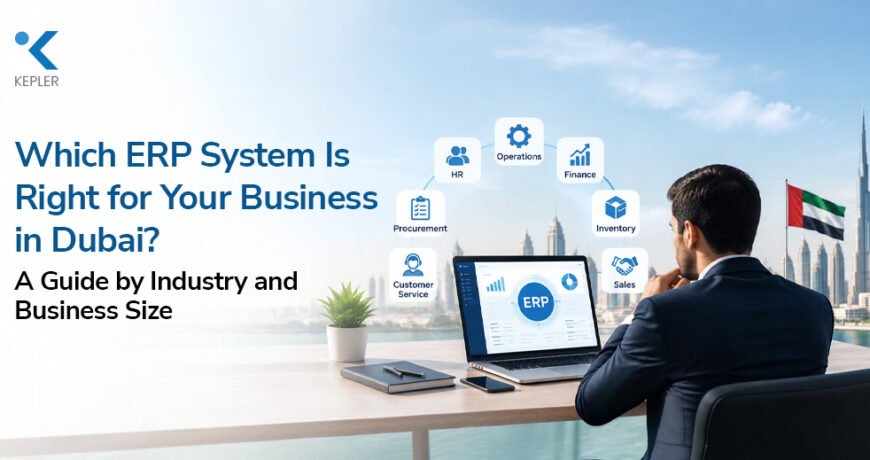
Which ERP System Is Right for Your Business in Dubai? A Guide by Industry and Business Size Leave a comment
Are your sales records, inventory details, financial reports, and customer information spread across different systems? As a business grows, managing these separate processes can become time-consuming and make it difficult to understand overall performance. This is where an Enterprise Resource Planning (ERP) system can make a difference.
For businesses in Dubai and across the UAE, choosing the right ERP software is not simply about selecting a platform with the most features. A trading company may need accurate stock tracking and supplier management, while a manufacturing business may prioritise production planning and material requirements. A service-based company, on the other hand, may need project tracking, timesheets, and invoicing.
So, which ERP system is right for your business? The answer depends on your industry, company size, existing workflows, and plans for growth. This guide explains what to consider when comparing ERP systems and how to identify a solution that fits your business requirements.
What Is an ERP System, and How Can It Help Businesses in the UAE?
Have you ever had to collect information from several departments just to prepare one accurate business report? An ERP system helps address this challenge by bringing key business processes together within a connected software platform.
An ERP system can combine functions such as accounting, inventory, purchasing, sales, human resources, and reporting. Depending on the software and modules selected, information entered in one department can also support related activities across the business.
For example, when a sales team confirms an order, the system may update inventory records, notify the purchasing team when stock is insufficient, and provide the information needed for invoicing. Instead of manually transferring the same information between disconnected tools, employees can work with shared records and coordinated workflows.
For companies evaluating an ERP system in UAE, this can improve visibility into business operations, reduce repetitive data entry, and support more informed decisions. However, the actual benefits depend on how well the software matches the company’s processes and how effectively it is implemented.
Not every business needs every ERP module. The goal is to identify the functions that solve your current problems while allowing room for future expansion.
Which ERP System Is Suitable for Different Industries in Dubai?
Does your business mainly sell products, manufacture goods, distribute stock, or provide services? Identifying your primary business activities is one of the most useful starting points when evaluating ERP solutions in Dubai. Different industries follow different workflows, so the features that benefit one company may be unnecessary for another.
ERP for trading and distribution businesses
Trading and distribution companies often manage multiple suppliers, product categories, warehouses, and customer orders. Without a connected system, stock records may become inconsistent, purchasing decisions may be delayed, and employees may struggle to track orders accurately.
An ERP system for these businesses should support inventory management, purchase orders, supplier records, sales orders, warehouse transfers, and financial reporting. Companies operating across multiple locations may also need consolidated stock visibility and location-specific reporting.
For example, a distributor can use integrated inventory and purchasing information to identify products approaching their reorder levels and plan replenishment more effectively.
ERP for retail businesses
Retailers need to manage products, sales, inventory, suppliers, and customer transactions. Businesses with physical stores and online shops may also need to coordinate stock across different sales channels.
When evaluating an ERP system, retailers should consider point-of-sale integration, product and pricing management, stock replenishment, customer records, and financial reporting. Ecommerce integration may also be important for businesses selling through their own websites or online marketplaces.
The right solution should help employees maintain accurate product information and understand which items are selling well, rather than requiring them to combine reports from several disconnected platforms.
ERP for manufacturing businesses
Manufacturing companies have different requirements because their operations involve converting raw materials into finished products. They need visibility into production schedules, material availability, work orders, and production costs.
An appropriate ERP system may include production planning, bills of materials, material requirements planning, quality management, and manufacturing cost tracking.
For instance, if a production order requires materials that are not available in sufficient quantities, the system should help the relevant teams identify the shortage and plan purchasing or production accordingly.
Businesses with complex manufacturing processes should verify that the selected ERP supports their specific production methods rather than assuming every platform includes advanced manufacturing capabilities.
ERP for service-based businesses
Consultancies, IT companies, maintenance providers, and other service businesses often need to manage projects, employees, client requirements, expenses, and invoices.
For these organisations, an ERP system may need project management, timesheets, resource allocation, expense tracking, billing, and profitability reports. Connecting project information with finance can help managers understand whether projects are progressing within budget.
For example, a service company can compare employee hours and project expenses against the agreed budget to identify cost overruns before they become larger problems.
Think about your own business: Which process causes the most difficulty today—inventory control, production planning, sales management, or project delivery? Start your ERP evaluation with that process and identify the other functions that need to connect with it.
How Does Business Size Affect Your ERP Choice?
Should a small business choose the same ERP system as a large organisation? Not necessarily. The right choice depends on transaction volumes, the number of users, operational complexity, and plans for growth—not just the current employee count.
Small businesses and startups
Smaller businesses may need a straightforward system that combines accounting, purchasing, sales, and basic inventory management. Ease of use, manageable costs, and a practical implementation process are often more important than advanced enterprise features.
A smaller company should avoid paying for complex modules that it does not currently need, while ensuring the software can support its essential processes.
Growing small and medium-sized enterprises
As a business expands, it may introduce new departments, additional locations, more employees, and larger transaction volumes. At this stage, ERP solutions UAE businesses consider should offer suitable integration options, configurable workflows, user permissions, and the ability to add relevant modules over time.
For example, a trading company that initially needs accounting and inventory management may later require warehouse controls, CRM integration, or more detailed purchasing reports.
Established and larger businesses
Larger organisations may need multi-entity reporting, complex approval workflows, advanced analytics, and integration with existing business applications. They may also require more extensive role-based access controls and detailed audit trails.
The best ERP in UAE for a particular organisation is therefore the system that matches its operational complexity and long-term requirements. A larger platform is not automatically better if it introduces unnecessary complexity.
What Features Should You Compare Before Choosing ERP Software?
Once you understand your industry and business size, how do you compare the available systems fairly? Instead of relying on feature lists or sales demonstrations alone, evaluate each platform against a consistent set of requirements.
Consider these important factors when comparing ERP softwares in Dubai:
- Industry suitability: Does the system support your actual business processes, such as distribution, retail, manufacturing, or project management?
- Integration: Can it connect with the accounting, CRM, ecommerce, payment, or other systems your business already uses?
- Reporting: Can managers access accurate information about cash flow, stock, sales, costs, and operational performance?
- Scalability: Can the system accommodate more users, transactions, locations, or modules as the company grows?
- Customisation: Can workflows be configured to meet your needs without creating excessive development and maintenance work?
- Implementation and support: Does the provider offer appropriate data migration, training, technical assistance, and ongoing support?
- Total cost: Have you considered licences or subscriptions, implementation, integrations, training, maintenance, and future upgrades?
For UAE businesses, financial workflows and local operational requirements also deserve attention. Ask how the system supports your accounting and tax reporting processes, and whether it can integrate with an accredited service provider where required for applicable UAE electronic invoicing obligations. Official guidance and deadlines should be verified with the UAE Ministry of Finance.
Before comparing products, write down your three most important business requirements. Ask each provider to demonstrate those specific workflows. This makes it easier to distinguish useful capabilities from features that look impressive but offer little practical value to your organisation.
Cloud ERP or On-Premises ERP: Which Is Better for UAE Businesses?
Have you considered where your ERP software will be hosted? Deployment affects how your organisation accesses, maintains, and manages its business data.
Cloud ERP is hosted by a service provider and accessed over a network, typically through a web browser or application. It can reduce the need to maintain your own server infrastructure and may make it easier for authorised employees to access the system from different locations. However, you should review subscription costs, internet requirements, security arrangements, backup policies, and data-hosting terms.
On-premises ERP runs on infrastructure managed by your business or its IT partner. It can provide greater direct control over the hosting environment, but the organisation is generally responsible for more infrastructure maintenance, updates, security management, and technical resources.
Neither option is automatically right for every business. A small company with limited IT resources may prefer cloud hosting, while an organisation with specific infrastructure or data-control requirements may evaluate on-premises or hybrid arrangements.
When comparing ERP software UAE providers, consider the total cost over several years, the availability of technical support, integration requirements, and the resources your team can dedicate to system maintenance.
How to Select the Right ERP Solution in Dubai
You have identified your business requirements and shortlisted a few systems. What should happen before you commit to one?
A structured selection process can help you avoid expensive mismatches and make implementation more manageable.
- Map your existing workflows. Document how orders, purchases, inventory, projects, and financial records move between departments.
- Identify recurring problems. Look for duplicated data entry, inaccurate reports, delayed approvals, stock discrepancies, or manual processes.
- Define essential requirements. Separate must-have functions from features that would be useful but are not essential.
- Shortlist suitable systems. Focus on platforms that fit your industry, company size, budget, and integration needs.
- Request realistic demonstrations. Ask providers to show how the system handles your actual business scenarios, not just standard features.
- Evaluate implementation and support. Discuss data migration, employee training, responsibilities, project timelines, and ongoing assistance.
- Plan for adoption. Prepare employees for the new workflows and test important processes before moving the entire business to the new system.
When selecting ERP solutions in Dubai, remember that the software itself is only one part of the decision. Implementation planning, accurate data, employee participation, and suitable support also influence the results.
Frequently Asked Questions
1. Which ERP system is best for a small business in Dubai?
The right system depends on the business’s industry, budget, workflows, and growth plans. A small trading business may prioritise inventory and purchasing, while a consultancy may need project management, timesheets, and invoicing. Compare systems against your essential requirements before choosing.
2. How do I compare ERP solutions in the UAE?
Compare industry suitability, core features, integration options, reporting, scalability, implementation costs, training, and ongoing support. Request demonstrations using your own business scenarios so you can assess how each system would work in practice.
3. Can one ERP system support different industries?
Some ERP platforms support several industries through configurable modules and workflows. However, specialised requirements may need additional functionality, integrations, or customisation. Confirm that the system can handle your specific processes before committing.
4. How long does ERP implementation take?
Implementation time depends on the number of modules, data quality, integrations, customisation, and employee readiness. A relatively simple project may take weeks, while a more complex implementation can take several months or longer. Ask the provider for a project plan based on your requirements.
5. What should I consider when choosing an ERP provider in Dubai?
Evaluate the provider’s understanding of your industry, implementation approach, data migration process, training, support arrangements, and ability to meet your technical and operational requirements. Make sure responsibilities, costs, and expected deliverables are clearly documented.
Conclusion
Choosing the right ERP system begins with understanding how your business operates today and what it needs to achieve in the future. Trading, retail, distribution, manufacturing, and service businesses all have different priorities, so the most suitable solution is one that supports essential workflows, provides reliable reporting, integrates with existing tools, and can adapt as the organisation grows.
Rather than choosing software based only on popularity or the number of features, compare systems against your actual requirements and evaluate the implementation support available.
Kepler Tech LLC, one of the best business solution providers in Dubai and across the UAE, can be a starting point for businesses exploring technology solutions for their operational needs. By identifying your priorities and evaluating suitable ERP options carefully, you can make a more informed decision that supports efficiency, visibility, and long-term business growth.