






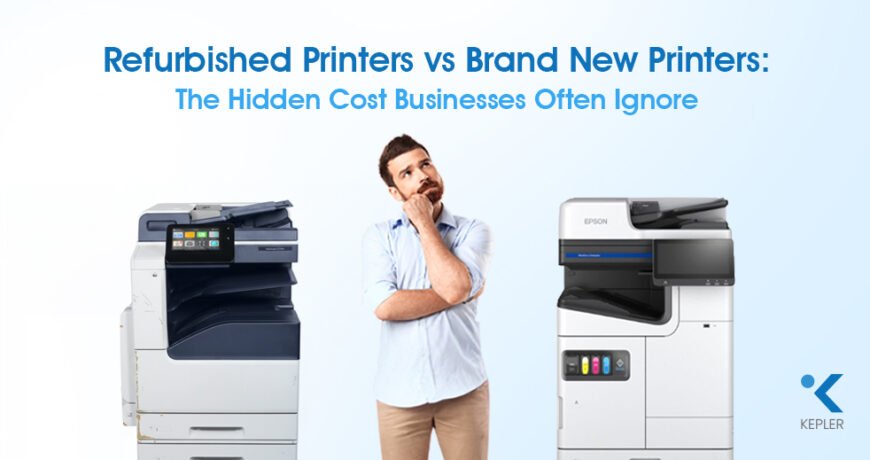
Refurbished Printers vs Brand New Printers: The Hidden Cost Businesses Often Ignore Leave a comment
In today’s fast-paced business environment, office printers are no longer simple peripherals; they are critical operational tools. From invoices and contracts to internal approvals, printing downtime can quietly disrupt workflows and affect productivity. When businesses evaluate printers, the decision often comes down to refurbished printers vs brand new printers. While refurbished options appear cost-effective at first glance, the long-term business impact is frequently underestimated.
These printers support daily documentation needs and play a silent but essential role in maintaining business momentum. Even a short disruption in printing can create workflow gaps, especially in departments that depend heavily on physical documentation for approvals and record-keeping.
What is a Refurbished Printer?
A refurbished printer is a device that has been previously used, returned, or replaced and then restored for resale or rental. Typically, worn parts are repaired or replaced, and the printer is tested to ensure it meets basic functional standards.
Because refurbished printers come from varied sources, their internal wear and tear can differ significantly from one unit to another. This inconsistency makes long-term performance harder to forecast, particularly in environments with continuous or high-volume printing demands.
Key characteristics of refurbished printers:
- Previously used hardware with a varied usage history
- Mixed component lifecycles
- Limited predictability in long-term performance
Although refurbished printers can function well initially, they often carry hidden operational risks, especially in demanding office environments.
What is a Brand New Printer?
A brand new printer comes directly from the manufacturer with unused components, updated firmware, and a full operational lifecycle ahead. These printers are designed to perform consistently under standard business workloads.
Since all components are unused, brand new printers typically perform more efficiently from day one. They are also better equipped to integrate with modern office systems and evolving business requirements.
Key advantages of brand new printers:
- Factory-fresh parts and components
- Predictable performance and lifespan
- Lower probability of unexpected failures
For organizations that rely on uninterrupted printing, these brand-new office printers offer stability that refurbished devices may struggle to match.
Upfront Cost vs Operational Cost: Understanding the Difference
One of the most common comparisons between refurbished and new printers focuses on initial price. However, businesses often overlook the broader concept of total cost of ownership (TCO).
Focusing only on purchase price can lead to incomplete cost analysis. A printer that appears affordable initially may generate higher expenses over time through maintenance, downtime, and operational inefficiencies.
Upfront cost considerations:
- Refurbished printers have a lower purchase or rental price
- Brand new printers require a higher initial investment
Operational cost considerations:
- Frequent servicing and part replacements
- Productivity loss due to printer downtime
- Increased IT or admin intervention
Over time, these indirect costs can exceed the initial savings gained from choosing a refurbished printer.
Printer Downtime Impact on Corporate Operations
Printer downtime rarely appears in financial reports, yet its effects are tangible across departments.
In fast-moving business environments, delays caused by printer issues often force teams to rely on temporary workarounds. These interruptions may seem minor individually, but they can significantly affect overall productivity when repeated.
Business impacts of printer downtime:
- Delayed document approvals and billing
- Interrupted client communication
- Idle staff waiting for print jobs
In corporate settings, even short interruptions can accumulate into lost hours and missed deadlines, turning minor technical issues into operational challenges.
Printer Maintenance & Support Reality
Maintenance requirements differ significantly between refurbished and brand-new printers.
As printers age, maintenance demands tend to increase, especially when parts are reused or nearing the end of their lifecycle. This can place additional strain on IT teams and external service providers.
Refurbished printer support typically involves:
- Reactive servicing after failures
- Higher likelihood of recurring issues
- Limited preventive maintenance options
Brand new printer support usually enables:
- Predictive and preventive servicing
- Fewer emergency breakdowns
- Streamlined support processes
For businesses prioritizing efficiency, consistent support plays a larger role than hardware cost alone.
Printer Security & Compliance Considerations
Printer security is often overlooked, yet it is increasingly relevant for modern offices.
With increasing focus on data protection and regulatory compliance, printers have become an extension of an organization’s IT infrastructure. Security gaps at the printer level can expose businesses to avoidable risks.
Potential concerns with refurbished printers:
- Outdated firmware and security patches
- Risk of residual data from previous use
- Limited compatibility with newer security standards
Brand new printers are generally better aligned with:
- Current data protection practices
- Secure firmware updates
- Compliance-ready office environments
For organizations handling sensitive documents, printer security is not optional—it is essential.
When Should You Choose a Refurbished Printer?
Despite their limitations, refurbished printers are not always the wrong choice. Evaluating print volume, document sensitivity, and operational dependency helps determine whether a refurbished printer can meet business expectations without compromising reliability.
They may be suitable for:
- Short-term or temporary projects
- Low-volume, non-critical printing tasks
- Backup or secondary printing needs
Understanding usage context helps businesses choose wisely without compromising essential operations.
Why Companies Prefer Brand New Printers
Large and growing organizations often prioritize predictability and reliability. Consistency in performance allows teams to focus on core responsibilities instead of troubleshooting equipment issues. This reliability becomes increasingly important as organizations scale their operations.
Brand new printers align well with corporate expectations because they:
- Reduce uncertainty in daily operations
- Support consistent print quality
- Reflect professionalism in client-facing environments
For corporates, printers are not expenses to minimize but tools to enable smooth business continuity.
Conclusion
Choosing between refurbished and brand-new printers is ultimately a strategic business decision. While refurbished printers may appear economical, brand new printers offer long-term reliability, predictable performance, and lower operational risk.
Looking beyond upfront savings enables businesses to make smarter, long-term investments in office infrastructure. Printer decisions should align with operational goals, security needs, and future growth plans.
For companies operating in the UAE, where service reliability and business continuity are critical, partnering with a trusted provider matters. Kepler Tech LLC – leading printer suppliers in the MEA region helps organizations across Dubai and the UAE select printing solutions that support growth, efficiency, and operational confidence, ensuring printers never become a bottleneck in business success.